440-496-7415
Google reviews that we have
Rating
4.8
585 reviews
Rick Lograsso
4 days ago
Posted on

Google

Kent Gilbert
5 days ago
After researching two other companies, both said 3 to 4 weeks for an estimate and 6 to 8 weeks for i...
After researching two other companies, both said 3 to 4 weeks for an estimate and 6 to 8 weeks for installation. Apex gave me the option to do a virtual estimate the same day. The virtual estimate was ballpark $300. Then Apex came out the next day to do the actual estimate which was $295. The install was completed the following week. I was concerned the replacement glass would not match the orginal double payne Andersen glass, but you can't even tell! Looks perfect!!! Great price, speedy service and quality work is hard to find these days! Highly recommend! Kent Gilbert Medina, OH
Read more Hide
Posted on

Google

Barbara Dees
1 week ago
arrived as scheduled, price quoted consistent, work excellent
Posted on

Google

Demetrius Booker
1 week ago
They were very professional and detailed in their work! They even cleaned up after themselves 👍🏽
Posted on

Google

channi zwick
2 weeks ago
Posted on

Google

Chris Olsen
3 weeks ago
Jay did an exceptional job and solved 2 thorny issues with an Andersen slider as both the screen and...
Jay did an exceptional job and solved 2 thorny issues with an Andersen slider as both the screen and the door both had issues and made it nearly impossible to use this expensive Andersen door. He fixed both issues quickly. He's a great guy, excellent communication skills, great personality and fantastic problem solving skills. Super impressed - thanks Jay and Apex Window Werks!
Read more Hide
Posted on

Google

Sue Hogan
3 weeks ago
Very timely and great work and value.
Posted on

Google

Patti Olszewski
4 weeks ago
We recently had 2 patio windows replaced, 2 new screens, and 2 windows that were hard to lift repair...
We recently had 2 patio windows replaced, 2 new screens, and 2 windows that were hard to lift repaired. Outstanding job from start to finish. Great communication, very professional, polite and tidy! I will be using Apex again for future business! Would highly recommend Apex if you're looking for any window repairs!
Read more Hide
Posted on

Google

Scott Himmel
4 weeks ago
High-quality work, reasonable price, respectful.
Posted on

Google

DW
1 month ago
We contacted the company after my wife got the number from one of their service vehicles. We had num...
We contacted the company after my wife got the number from one of their service vehicles. We had numerous fogged panes that needed attention. Once contacted, the estimate was provide quickly. Most of the glass was tempered and needed to be ordered special. This added about one week to the install date. We had 14 casement glass panes repaired in one visit. The windows were aluminum clad wood windows. I was concerned about having these 25 year old windows being dismantled to replace the panes. During the estimate Ben assured me this would not be an issue. The gentlemen that performed the work, were both polite and extremely efficient. The work was completed on all windows in just one visit. We did have a slight issue with one window. After contacting Apex the fix was handled quickly and with no issues. If you have fogged glass don't wait. The comfort level in the home was noticeable immediately. I would highly recommend Apex if you're in need of this kind of work. Having Apex replace the fogged glass saved me thousands of dollars over purchasing new windows. Thanks again for a job well done.
Read more Hide
Posted on

Google

Load more
4.8
Read our 585 reviews

WALK-INS ARE WELCOME, SAME DAY SERVICE!

Insulated Glass Replacement in Northeast Ohio

An insulated glass unit is a consumable part of a window, not a permanent one. The frame, the sash and the hardware can all outlast the sealed glass inside them by decades, which is why replacing the unit alone is so often the correct repair.

Apex Window Werks has been fabricating and fitting replacement IGUs across the Cleveland–Akron area since 2016, matching thickness, coating and spacer to what the opening already holds.

Virtual estimates
THE PROBLEM

Every Sealed Unit Is Built With a Working Life

A sealed unit is two or three panes bonded to a spacer bar, with the cavity between them filled with argon or krypton and the spacer packed with desiccant to absorb any moisture that gets past the primary seal. That assembly is under constant mechanical stress. Every temperature swing expands and contracts the gas inside, flexing the seal at the edge, and every one of those cycles takes a fraction off the sealant's working life.

The desiccant absorbs incoming vapour until it saturates, and past that point the unit has no defence left. Fogging is not the failure itself, it is the moment the failure becomes visible, and the loss of insulating gas has usually been under way for a year or more before anyone notices a haze.
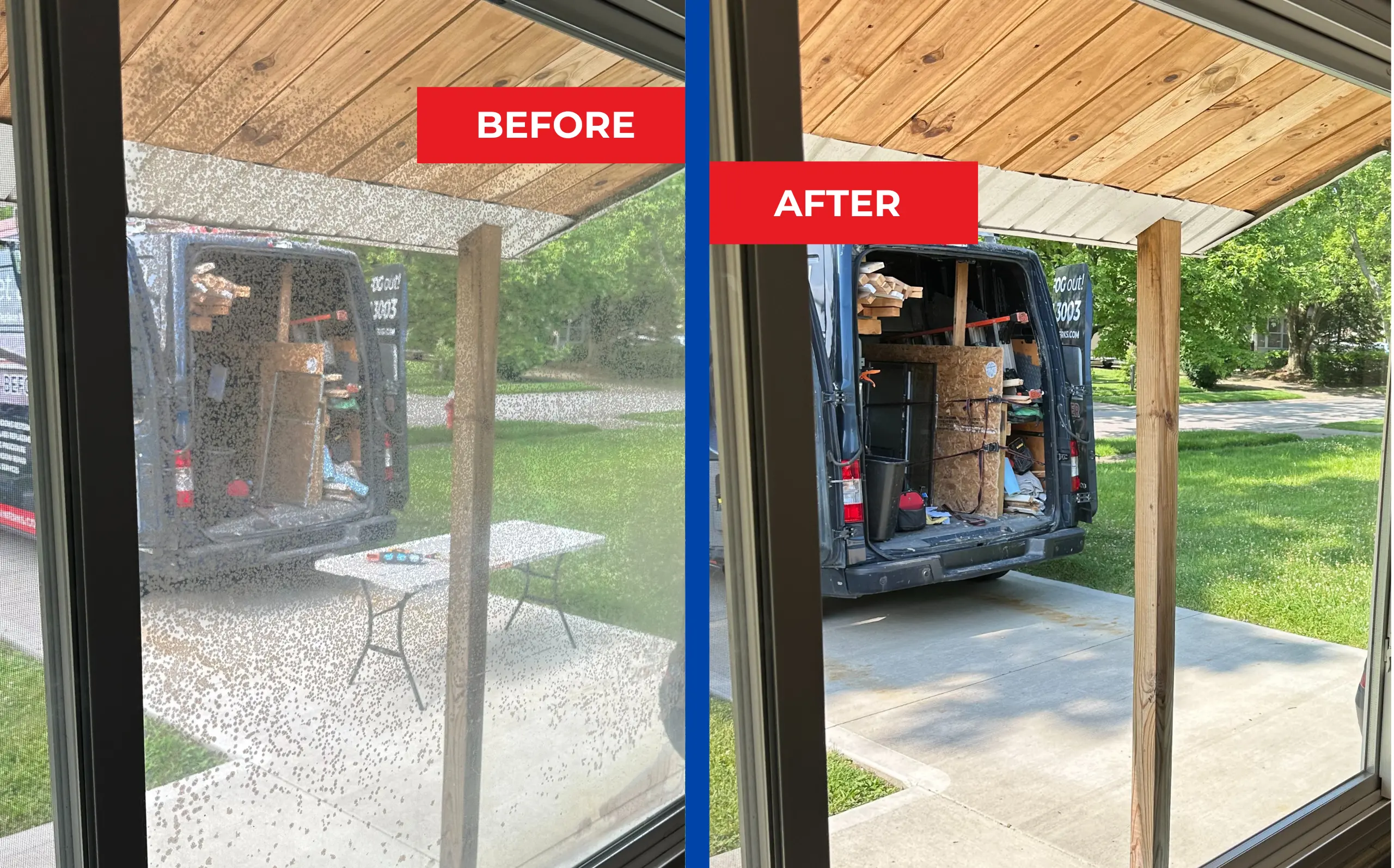
Northeast Ohio pushes those cycles harder than most of the country. A single January day here can run from a sub-zero night to sun on a south-facing elevation at midday, which is a far greater swing across the glass than the annual average temperature would suggest. Add the humidity that comes off the lake through autumn and the seal is working against pressure from both directions.

It shows in the pattern of calls: the 1990s subdivisions we work in around Strongsville and Twinsburg tend to lose several units within the same two or three years, because the whole house was glazed at once and every unit has been through an identical number of cycles.

SAME DAY EMERGENCY WINDOW REPAIR IN JUST 2 HOURS!

Bring your window to our workshop, and we'll have it repaired and ready for installation in just 2 hours! Our team, specialized in rapid response, is adept at providing quick and efficient service for emergency repairs.

OUR APPROACH

What Goes Into a Replacement Unit

Every replacement starts with measurement, and the measurement is more involved than a height and a width. We record the daylight opening, the rebate depth, the overall unit thickness, the pane count, the position and colour of any low-emissivity coating, the spacer type, and whether the original carried a grid pattern between the panes.
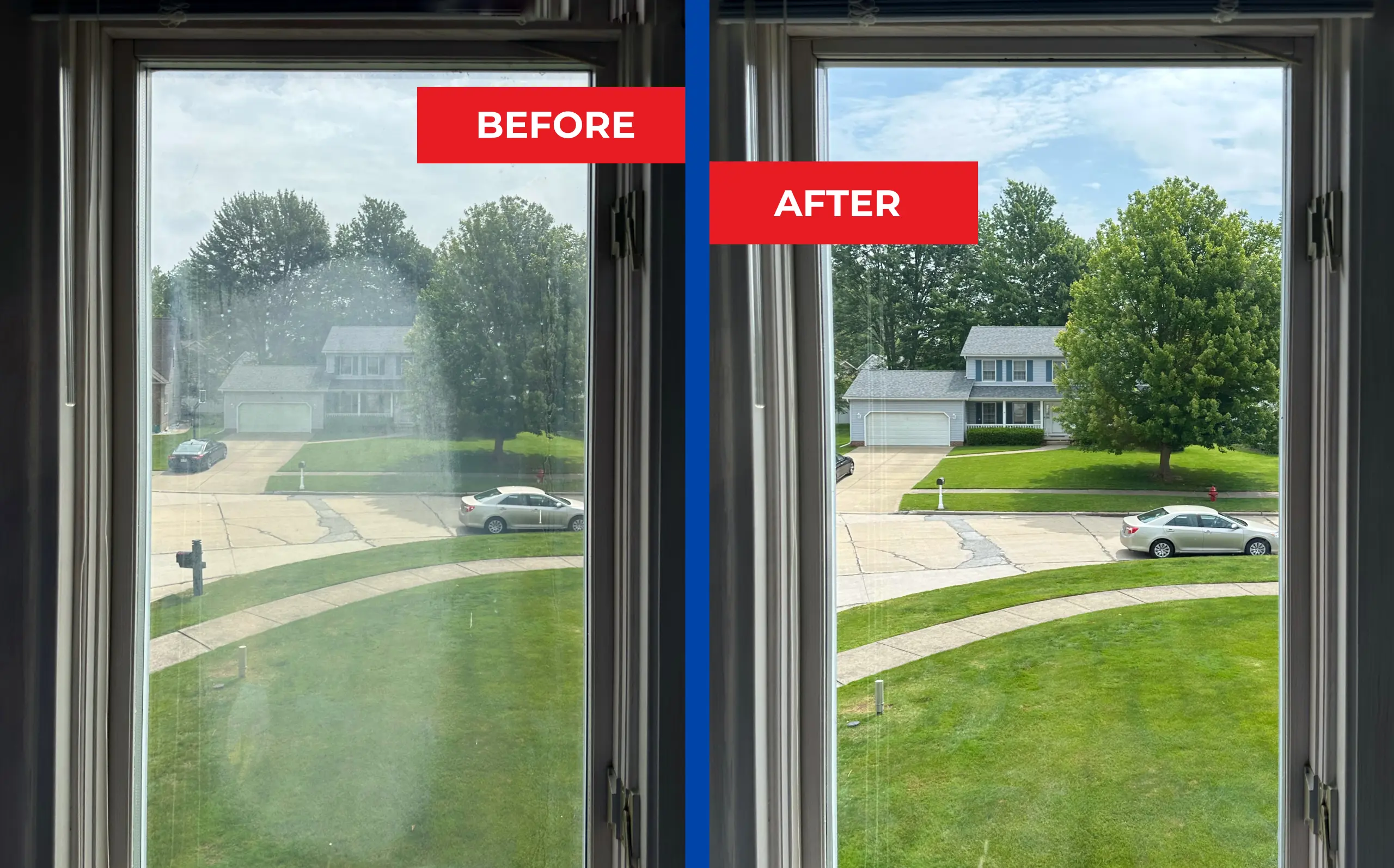
Getting the coating surface wrong is the most common error we are called in to correct after somebody else's work: a low-E layer applied to the wrong face of the wrong pane changes how the unit performs in winter, and the glass will look identical while doing the opposite of what it should.


Fabrication happens to those measurements rather than to a stock size. The new unit is built with a warm-edge spacer where the frame allows one, sealed with a dual-barrier system, charged with inert gas and packed with fresh desiccant. Where the original was tempered – and near doors, in bathrooms and close to floor level it usually was – the replacement is tempered too, because that is a safety requirement rather than a preference. Obscure, tinted, laminated and grid-bearing units are all fabricated the same way, matched to what came out.

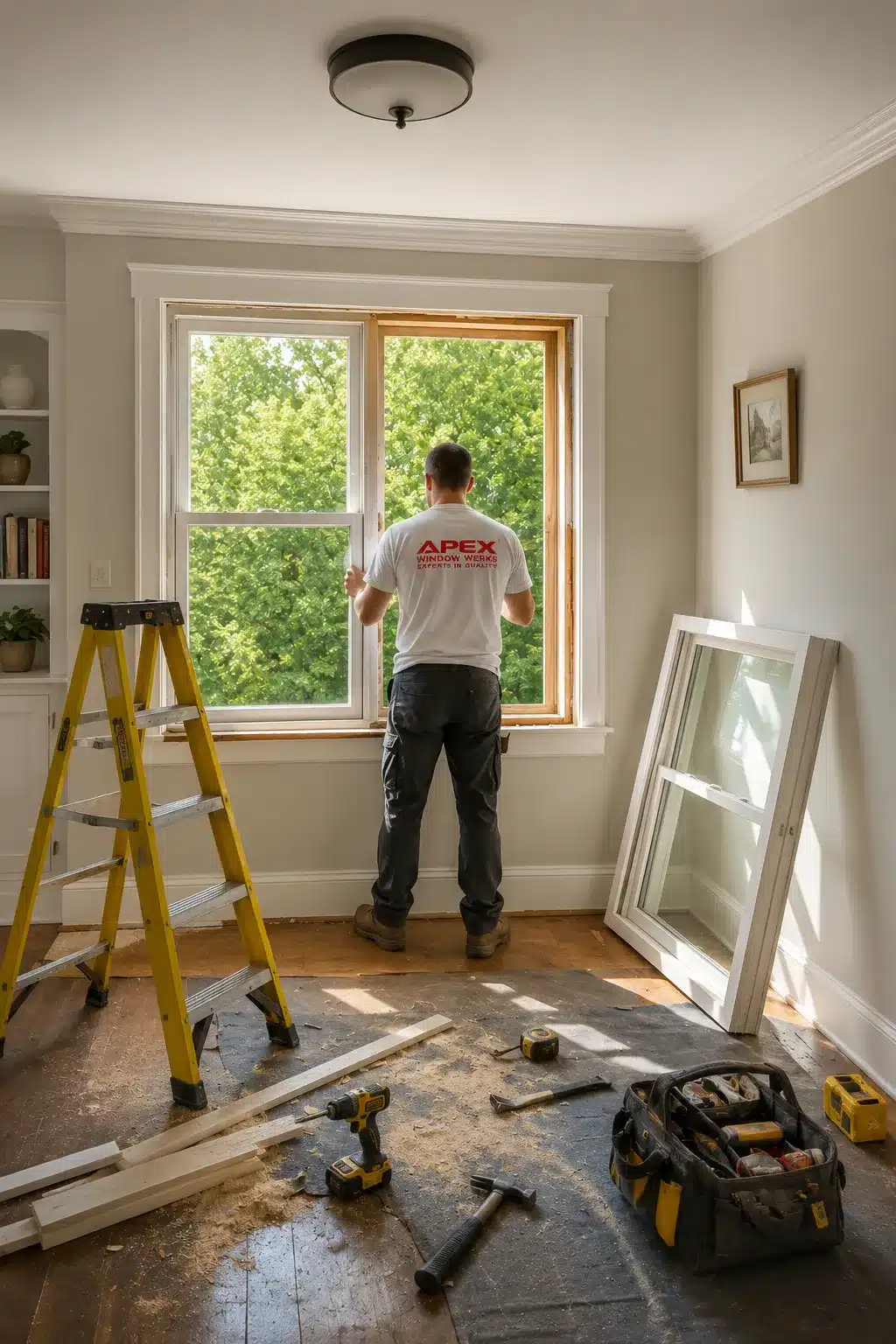
Fitting is where the frame gets its own assessment. Stops come off, the old unit is lifted out, and the rebate is cleaned back and checked for standing water, blocked weep paths and any decay in the surrounding timber or vinyl. Setting blocks go in at the correct quarter points so the unit's weight is carried properly rather than resting on the frame, and the glazing is sealed and the stops refitted. If the surrounding material turns out to be compromised, our rotten window repair service deals with that first – fitting a new sealed unit into a wet rebate simply shortens the life of the new glass.

Haze That Will Not Wipe

The first sign is almost always a film that resists cleaning from both sides. People wash the interior, then the exterior, then conclude the glass is permanently dirty. It is not dirt: it is moisture that has entered the sealed cavity and condensed on surfaces nobody can reach without cutting the unit apart. Once it appears, the primary seal has already been compromised for some time.

Early on the haze comes and goes with the weather, clearing on dry days and returning on humid ones, which is why homeowners often dismiss it for a season or two before mentioning it. As the desiccant saturates, those clear intervals get shorter until the fogging becomes permanent. There is no serviceable repair for a breached seal, but the frame around it is almost always untouched, and that is precisely what makes glass-only replacement possible.

STREAKING BETWEEN PANES

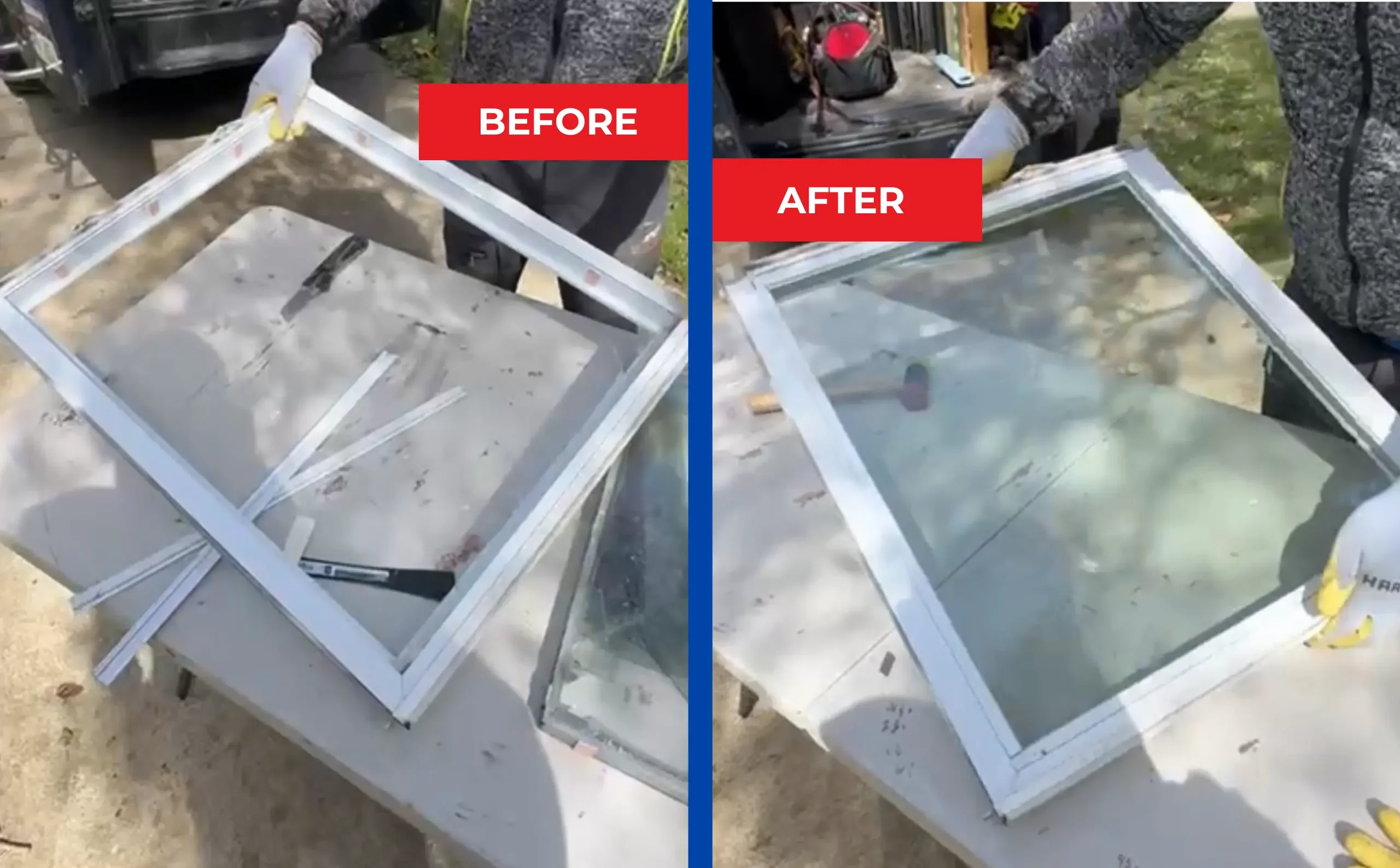
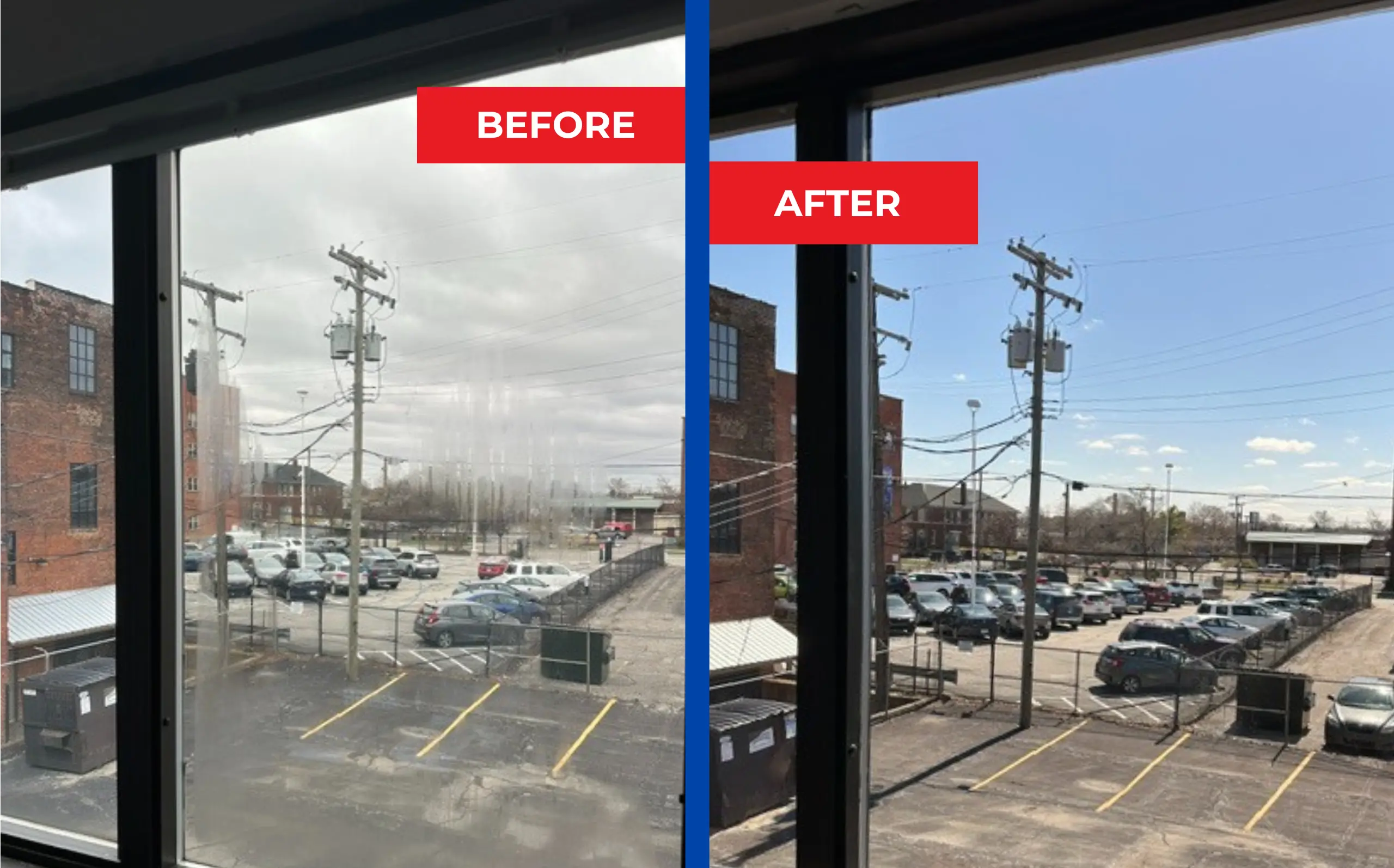
After a unit has been holding moisture for a few years, the water starts leaving deposits behind on surfaces nobody can reach. These show as pale streaks, spots or a chalky bloom across the inner glass faces, most visible in low winter sun. The pattern usually runs from the bottom edge upward, following the path where condensation has repeatedly pooled and evaporated against the interior face of the outer pane.

Streaking tells us the failure is not recent. It also tells us the unit has been losing its gas fill for long enough that thermal performance has dropped well below what the window was rated for on the day it was installed. Homeowners frequently report that the room felt noticeably colder for a couple of winters before they ever connected that discomfort to the appearance of the glass.

One Pane Colder Than the Rest

A useful test on a winter morning is simply to touch the glass. A functioning sealed unit keeps its interior surface close to room temperature; a failed one, with its argon gone and replaced by ordinary air, will read noticeably colder to the hand than an identical window a few feet away. That difference is measurable and it is the clearest evidence that insulating performance has dropped.

Occupants usually feel it well before they see it. The complaint arrives as a draught near the window, a chair nobody wants to sit in, or a room that never quite warms through, and the assumption is almost always that air is leaking in around the frame. Often the frame is perfectly sealed, and the heat is simply conducting straight out through glass that no longer insulates.

CONDENSATION ON THE INSIDE

Interior condensation on the room-facing surface is a different fault from fogging inside the cavity, and the two get confused constantly. Water forming on the inside face means the glass surface has dropped below the dew point of the room air. On a failed unit that happens far more readily, because the inner pane is now being chilled by the outdoor temperature almost directly.

The consequence is not confined to the glass itself. Water runs off the pane onto the sill below, sits against the paint film and, given a few seasons of that cycle, begins the decay that turns a straightforward glass job into a carpentry one. Where that has already started, our sill, sash and frame repair work is carried out alongside the glass replacement rather than left until afterwards.

Cracked or Chipped Outer Pane

Impact damage to one pane of a sealed unit cannot be repaired in isolation. Even a chip that has not spread will eventually breach the edge seal as the glass flexes through its temperature cycles, and a crack has already broken the pressure boundary. The unit is a single sealed assembly, so damage to either pane means the whole unit is replaced.

The good news is everything that does not need replacing. Frame, sash, hardware, grids and finish all stay exactly where they are, and on a modern window the sealed unit represents only a fraction of the cost of the whole assembly. This is the single most common situation in which homeowners are quoted for complete replacement windows when one fabricated pane would have restored the opening entirely.

Grids Detached or Sagging

On units with grids sealed between the panes, the bars are held by clips at the spacer. When the seal fails and moisture cycles through the cavity, those clips corrode and release, leaving a grid that sits crooked or drops out of alignment behind glass nobody can open. It looks like a cosmetic fault and it is treated as one, but it is a symptom.

A sagging internal grid is effectively proof of seal failure, because a sound unit stays dry inside and its clips have nothing to corrode against. We build replacement units with grids matched in profile, colour and spacing to the originals, so that one replaced unit reads identically to the untouched windows on either side of it rather than drawing the eye.
THE FACTORS

Housing Built Between 1985 and 2005 Ages Differently

The suburban building boom that filled out Northeast Ohio's outer ring produced tens of thousands of homes glazed with early-generation double-pane units. Those units were a genuine advance on single glazing, but the sealant chemistry and spacer design of the period do not match what is fabricated today. Aluminium spacer bars conduct cold directly across the edge of the unit, which concentrates condensation exactly where the seal is, and the dual-seal systems now standard were not universal then. A house from that era is not badly built – it is simply holding a component that has reached the end of a normal working life.

The pattern follows elevation as much as age. South and west-facing glass takes the greatest daily temperature swing and fails first, north elevations often outlast it by years, and large fixed units fail before small operable ones because there is more glass area flexing against the same length of seal. In practice that means the failures cluster: three or four units on one side of a house, none on the other. It is a pattern we see repeatedly in the newer housing around Broadview Heights, and the same clustering shows up in Macedonia where subdivisions were completed in a single phase.

Get a free estimate

How Long a New Sealed Unit Should Last

A properly fabricated replacement unit should give twenty years or more, and the variables that decide where in that range it lands are mostly outside the glass itself. Frame condition matters most: a unit set into a rebate that drains properly, on setting blocks that carry its weight at the quarter points, is under far less stress than one bearing directly on a frame. Orientation matters next, and after that, whether interior humidity is being managed. We ask about bathroom and kitchen ventilation on assessment for exactly this reason, because a house running consistently high humidity will work its seals harder regardless of what glass goes in.

On cost, the arithmetic is what makes this service worth asking about at all. Apex's own guide to fixing a broken window sets out the rule of thumb our estimators use daily: repair typically runs about a third of the price of full replacement, and across a house with several failed units that difference compounds quickly. Glass-only work also avoids disturbing trim, siding and interior finishes, which is a hidden cost of replacement that rarely appears on a quotation. Homeowners we assess in North Royalton and comparable suburbs are frequently weighing a whole-house replacement quote against a handful of units that actually need attention, and the honest answer is usually the smaller job. When the frames genuinely have gone, we say so and discuss full replacement windows instead.

Get a free estimate
Step 1
Step 2
Step 3
Step 4
Step 5
01
Our Insulated Glass Replacement Process

Confirming the Seal Has Actually Failed

Not every cloudy window is a failed unit, and diagnosing it correctly saves people money. Surface condensation, hard-water deposits from sprinklers and residue from cleaning products all mimic seal failure from a distance. We check which surface the haze is on by testing from both sides, and if it wipes away from either face, the sealed unit is intact and the problem is something else entirely.

Where the fault is genuine, we assess the surrounding assembly at the same visit. Frame material and condition, rebate drainage, stop type and whether the unit is fixed or operable all affect how the replacement is fitted. Our foggy window repair service covers the diagnostic side of this in more detail, including the cases where the frame rather than the glass is the real problem.
02
Our Insulated Glass Replacement Process

Measuring and Specifying the Unit

Measurements are taken from the opening itself rather than from the old glass, because a unit that has sat in place for twenty years may well have shifted within its rebate. We record daylight opening, rebate depth, overall thickness, pane count, coating type and surface position, spacer type, gas fill and any grid pattern, then photograph the existing unit in situ so the fabricator is working from evidence rather than description.

Specification decisions get made with you at this stage rather than quietly assumed on your behalf. Whether to match the original low-E coating or upgrade it, whether tempering is required by the opening's position in the wall, and whether a warm-edge spacer will physically fit the existing rebate are all choices with real consequences for comfort and cost, and each one is explained before anything is ordered.
03
Our Insulated Glass Replacement Process

Fabrication to Your Measurements

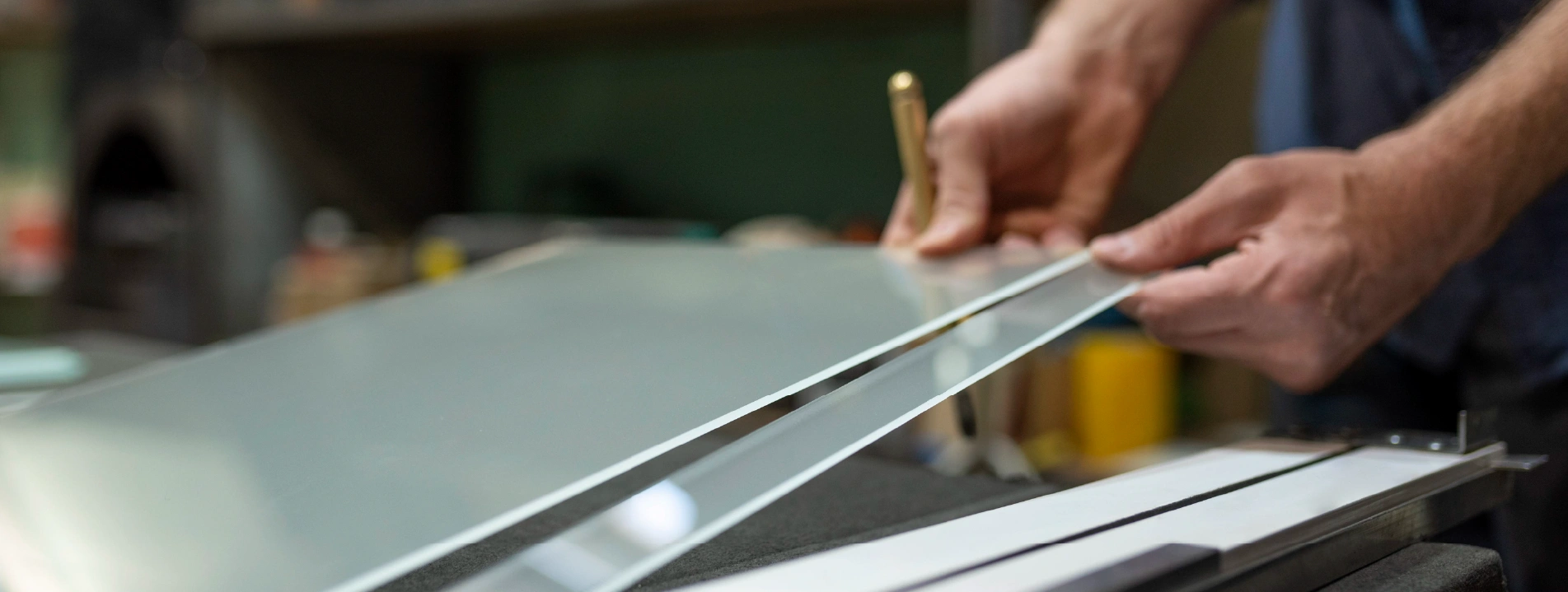
The unit is built to the recorded dimensions with fresh desiccant packed into the spacer, a dual-barrier edge seal and a full inert gas charge. Grid bars, obscure patterns, tints and laminated interlayers are all incorporated during fabrication rather than added afterwards, because building them in is the only way to get them sitting correctly and permanently inside a sealed cavity.

Lead time depends entirely on what the unit involves. Standard clear and low-E units move quickly; tempered, laminated, oversized and pattern-matched grid units take longer because each is made to order for one opening. We give a realistic date at the point of measuring rather than an optimistic one, and we never remove the old glass until its replacement is physically on hand.
04
Our Insulated Glass Replacement Process

Removal and Rebate Preparation

Stops or beads come off carefully so they can be reused, since replacements rarely match the existing finish exactly. The failed unit is lifted out whole where possible, and the rebate is then cleaned back to bare material and inspected properly – this is the only occasion the frame's interior is ever visible, so it is worth the time.

Weep paths get cleared, standing water is dried out, and any damaged material is addressed before glass goes near the opening. On timber frames this frequently means priming bare wood; on vinyl and aluminium it usually means clearing drainage that has silted up over two decades. Skipping this stage is the single most reliable way to make a new unit fail early.
05
Our Insulated Glass Replacement Process

Setting, Sealing and Checking

Setting blocks are positioned at the quarter points so the unit's weight transfers into the frame correctly rather than bearing on a corner, which is what causes edge-seal stress and premature failure. The unit is bedded, the stops are refitted, and the perimeter is sealed on the surfaces that should be sealed while drainage paths are deliberately left open.

Before leaving we check the sash operates through its full travel, the locks still draw it closed against the weatherstrip, and the glazing sits square in the opening. On operable units the added weight of a modern unit occasionally needs a balance adjustment, and that gets handled in the same visit rather than becoming a second call-out.

Pella Glass Replacement

Pella units across their wood, clad-wood and vinyl lines use proprietary glazing dimensions that rarely match a generic stock size, and their between-the-glass grid and blind systems add further complexity to what looks from the outside like a straightforward replacement. Getting the spacer type and rebate depth right is what determines whether the new unit seats flush or sits proud of the bead.


We fabricate replacement units to the recorded dimensions of your existing Pella glazing, matching coating type, grid profile, thickness and colour so that a single replaced pane is indistinguishable from the untouched windows beside it. Current glazing specifications are published by Pella, and our Pella window and door repair page covers the wider range of work we handle on these units.

Andersen Insulated Glass Units

Andersen's High-Performance glazing packages have changed specification several times over the decades these windows have been sold across Northeast Ohio, which means an accurate replacement depends entirely on identifying what is physically present in the opening rather than trusting what the series name on the frame implies. Coating surface position in particular varies between generations of otherwise identical-looking units.


Our approach is to record and match rather than assume, so that the replacement performs the way the original was engineered to perform and not merely the way it appears to the eye. Product and glazing information is available from Andersen, and our Andersen windows and doors service sets out what we handle across both current and long-discontinued lines.

Guardian SunGuard Glass

Guardian's SunGuard range is a coated glass product rather than a window brand, which means it turns up inside sealed units built by many different manufacturers. That distinction matters when replacing one pane in a multi-window elevation, because the coating governs reflectance and tint, and a mismatched substitute is visible from the street in certain light conditions.

We source and fabricate to the correct SunGuard specification wherever that is what the building already carries, rather than substituting a nominally equivalent coating that reads differently under low winter sun. Coating performance data is published by Guardian Glass, and our Guardian SunGuard glass replacement page explains how we match existing coated glazing across a full run of windows.

SuperSeal Windows and Doors

SuperSeal vinyl units are common throughout Northeast Ohio's later-1990s housing, and their sealed glass has generally reached the stage in its working life where fogging appears across several openings within the same year or two rather than singly. The vinyl frames themselves usually remain entirely serviceable, which makes glass-only replacement the obvious and far cheaper route.


We replace the sealed units and leave the frames, sashes, hardware and exterior finish exactly where they are, restoring insulating performance without any disturbance to the outside of the house. Details of what we cover appear on our SuperSeal windows and doors repair page, including the balance and hardware work these windows often need at the same age.

Visions Windows and Doors

Visions vinyl windows were installed widely across the region's suburban subdivisions, and we most often encounter them with failed units in large fixed picture openings and in the fixed lites of sliding assemblies. Those larger panes flex considerably more against the same length of edge seal, which is why they consistently fail ahead of the smaller operable sashes in the same wall.

Replacement units for these openings need accurate thickness matching to seat correctly in the existing glazing bead, since the pocket depth on a vinyl frame cannot be altered to accommodate a unit built even fractionally oversize. Our service covers sealed unit replacement alongside the sash and hardware repairs that frequently accompany it on windows of this generation.

Gerkin Windows and Doors

Gerkin's aluminium and vinyl products appear in both residential and light commercial settings around Cleveland and Akron. Their aluminium-framed units in particular concentrate cold at the glazing perimeter, which drives condensation to form directly along the seal line and measurably shortens the working life of the sealed unit compared with a vinyl equivalent in the same wall.

Where the existing rebate has sufficient depth to accept one, we fit replacement units built around a warm-edge spacer specifically to cut that conduction at the perimeter and keep the seal drier through winter. Our Gerkin windows and doors repair page sets out the glazing, sash and hardware work we carry out across their residential and light commercial ranges.

Reading the Numbers on a Glazing Specification

Every rated window carries performance figures, and two decide almost everything about how a replacement unit behaves. U-factor measures how readily heat conducts through the assembly, where lower means less heat escaping in winter. Solar heat gain coefficient measures how much solar energy passes through, where lower means less unwanted warmth in summer. Both are certified independently, not claimed.

In a heating-dominated climate like this one, U-factor deserves more weight than solar heat gain, and a moderate SHGC on south-facing glass is genuinely useful in January. The National Fenestration Rating Council certifies these ratings and administers the labelling programme, and its explanations are worth reading before choosing a coating. Specifying a replacement unit means choosing where on those two scales the new glass sits.

WHY THE SPACER MATTERS MORE THAN THE GAS

Most conversations about sealed units focus on argon, and the gas does real work. But the component that most often determines how long a unit lasts is the spacer bar holding the panes apart, because it carries the seal and it conducts. A conventional aluminium spacer moves heat straight across the edge of the unit, which chills the perimeter of the inner pane, drives condensation to form exactly along the seal line, and works that sealant harder every single day.

Warm-edge spacers, made from structural foam or thin stainless steel, cut that conduction substantially. The visible benefit is less condensation at the glass edge in winter; the invisible one is a seal that spends far less of its life wet. Where the existing rebate has the depth to accept one, we specify warm-edge as a matter of course, which is a specification most original builder-grade units in this region never had.

Sealed Units in Doors Are a Different Job

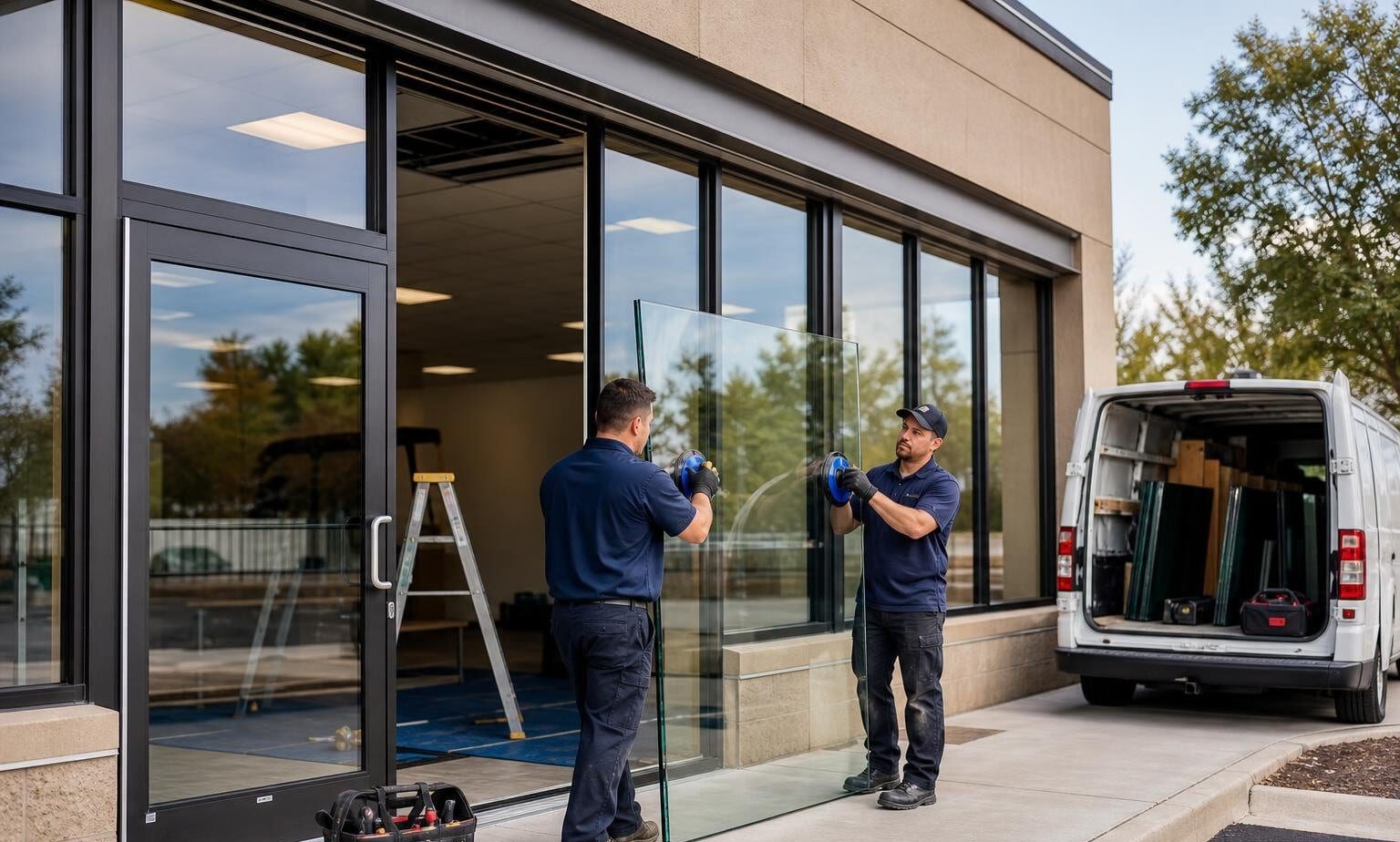
Door glazing behaves differently from window glazing and gets treated accordingly from the outset. A sliding patio door panel or a French door lite absorbs impact and vibration every single time the door is used, which puts the edge seal under a form of mechanical loading that a fixed window never experiences across its whole life. Almost all door glass is tempered by code, and the replacement must be tempered too, without exception.


Sliding panels add a further consideration: the panel has to come out of its track to be reglazed, and the rollers underneath it are typically the same age as the failed glass. We check and service those at the same time, because reinstalling a heavy panel onto worn rollers puts the new unit under exactly the racking stress that shortens seal life. Our guide to what to do when sliding door glass breaks covers the immediate steps if a panel has already gone.

Sealed Units We Have Replaced Recently

Glass work photographs well for one reason: the before-and-after difference is total. Both projects below kept the original frame, sash and finish entirely intact, with only the sealed unit changed.

Foggy window glass replacement in Sagamore Hills, OH – a fogged panel replaced while the surrounding frame, still sound, stayed exactly where it was.

Broken window glass replacement in Brecksville, OH – impact damage to a single pane, resolved with a fabricated unit rather than a new window.
BY WINDOW TYPE

Not Every Opening Takes the Same Sealed Unit

The unit that goes into an opening is decided by three things: how large the pane is, whether the sash moves, and where the opening sits in relation to doors, floors and wet rooms. Size drives glass thickness, because a large pane needs more substance to resist wind loading without flexing, and flexing is what kills edge seals. Movement drives weight considerations, since a heavier modern unit in an operable sash can overwhelm balances that were specified for the original glass.

Position drives safety requirements, and those are not discretionary – glazing within a defined distance of a door, close to floor level, or in a bathroom must be tempered or laminated regardless of what was originally installed there. Frame material adds a fourth variable. Timber rebates can usually accept a thicker warm-edge unit; vinyl and aluminium pockets are often fixed in depth, which constrains what can go in without modifying the frame.

Coating choice then follows orientation rather than habit, since the correct specification for a shaded north elevation is not the correct one for unshaded west-facing glass. Where an assessment shows the frame itself is beyond taking a new unit, we discuss house window repair and replacement options honestly, and where the timber around the opening has started to go, wood window restoration comes first.
Get a free estimate

Large Fixed and Picture Windows

These fail earliest and most often, because one expanse of glass flexes more against its seal than any operable unit does. They also demand the most accurate measurement, since no sash absorbs a discrepancy.

Casement and Awning Sashes

Outward-opening sashes carry their glass on hinges and an operator arm, so unit weight affects how the window works. A heavier replacement can strain the operator, which is why hardware is assessed alongside the glass.

Sliding Doors and Door Lites

Door glazing is tempered by code and handled as safety glass. Panels come out of their tracks for reglazing, rollers are inspected while the panel is out, and the unit is checked for square so the seal carries no racking load.

WHAT OUR INSULATED GLASS REPLACEMENT SERVICE COVERS

The glass has a working life. The window it sits in usually has a much longer one.
Replacing the sealed unit alone restores the insulating performance the window was rated for, without disturbing the frame, the trim or the finish around it.

We fabricate and fit replacement insulated glass for wood, vinyl, aluminium and clad frames across residential and light commercial properties: clear, low-emissivity, tempered, laminated, obscure, tinted and grid-bearing units, in double and triple pane, matched to what the opening already carries. The frame stays, the sash stays, the trim and siding are never disturbed, and the finish inside and out is untouched. That approach is the reason people find us when searching for insulated glass replacement near me, and it has been how we have worked since we opened in 2016.


Coverage runs across the Cleveland–Akron corridor and the communities either side of it, including Seven Hills, Brecksville, Bay Village and Cuyahoga Falls. Because failures cluster by construction phase rather than by town line, a technician who has measured a dozen units in one subdivision already knows the glazing system in the next street over, which shortens assessment time and makes the quote more accurate the first time.


Not seeing your town here does not mean we do not reach it. Call 440-496-7415 or send photographs of the affected windows through our contact page and we will tell you what we are looking at. Estimates are free, and if the haze turns out to be on the surface rather than inside the unit, we will say so and you will not need us at all.

FAQ

CAN YOU REPLACE JUST THE GLASS WITHOUT REPLACING THE WHOLE WINDOW?

In most cases yes, and it is usually the correct call. If the frame and sash are structurally sound, the sealed unit can be removed and a new one fabricated to fit the same opening, leaving the trim, siding and interior finish untouched. Full window replacement only becomes the better option when the frame itself has failed.

MY WINDOWS ARE ONLY 12 YEARS OLD – SHOULD THE SEALS HAVE FAILED ALREADY?

It is earlier than ideal but not unusual, particularly on large south or west-facing panes with aluminium spacer bars. Original builder-grade glazing in this region commonly starts fogging between ten and twenty years in. A replacement unit specified with a warm-edge spacer should outlast the one coming out.

DO I NEED TO BE HOME WHEN THE INSULATED GLASS IS REPLACED?

For interior-glazed windows, yes, since we need access to the room to remove the stops and set the new unit. Most single-unit replacements take under an hour once the glass is on site. We arrange access in advance so the visit is a fitting appointment rather than another assessment.

ARE FAILED SEALS MORE COMMON IN NORTHEAST OHIO THAN ELSEWHERE?

The failure rate here does run ahead of milder regions, and the reason is temperature cycling rather than cold alone – daily swings across a sunlit pane in winter are severe. Lake humidity through autumn adds vapour pressure against an already-stressed seal. Our foggy window repair page goes further into how the local climate drives it.

IS TEMPERED GLASS REQUIRED FOR WINDOWS NEAR A DOOR OR STAIRWAY?

Frequently, yes. Building codes define hazardous locations – glazing near a door edge, close to floor level, beside stairs and in bathrooms – where safety glazing is mandatory. We identify these during measuring and specify tempered or laminated glass accordingly, whatever was fitted originally.
Still have a question?